
Criminal Court Cases in Essex County
Essex County criminal court cases are divided by court level and offense location. The twenty Town and Village Justice Courts hear misdemeanors, violations, traffic and local offenses. They also conduct arraignments and preliminary steps in felony matters. A felony can begin in one of those local courts and later proceed to Supreme Court in Elizabethtown. County Court also exercises criminal jurisdiction. In New York, the name “Supreme Court” identifies a trial court, not only an appellate court.
The Essex Supreme and County Court clerk keeps its court case files at 7559 Court Street, Elizabethtown, NY 12932. The clerk line is (518) 873-3370, the fax is (518) 451-8738, and email is EssexSupremeCo@nycourts.gov. A local Justice Court remains the custodian of a local docket unless the case has moved. Ask which court holds the exact record before requesting a copy.
Essex County Justice Courts Start Cases
The place of the alleged offense is the best first clue. A ticket, appearance paper, police report, or bail receipt may name the arraigning court and show a docket or ticket number. Lake Placid Village Court, Ticonderoga Town Court, Saranac Lake Village Court, and other local courts maintain their own records. Saranac Lake needs extra care because the village spans Essex and Franklin Counties. The village name alone does not establish which county clerk will hold a later felony file.
Call the local clerk with the defendant’s full name, date of birth, approximate appearance date, and known docket number. Ask whether the case remains local, is archived, or was transferred after indictment. The Essex County District Attorney prosecutes in Supreme Court, County Court, and twenty local courts, but the DA is not the public case-file custodian. That countywide role helps explain why one prosecution may leave entries in more than one clerk’s system.
Essex County Case Record Searches
No single portal displays every Essex County criminal case file. Use the court clerk for the local docket and certificate, then use OCA Criminal History Record Search, or CHRS, for a statewide exact-name and date-of-birth report. CHRS covers electronically reported pending cases and convictions, but it is not a certified disposition. WebCriminal/eCourts can provide limited calendar and appearance information. NYSCEF guest search is aimed chiefly at e-filed Supreme Court records and is not a full criminal-history search.
- Identify the offense location and originating court from the papers tied to the case.
- Call that clerk with the exact name, date of birth, date range, and docket or ticket number.
- For an indicted felony, contact the Supreme and County Court clerk in Elizabethtown.
- Review the docket and request the public pleadings, orders, or disposition needed.
- Ask the originating clerk for a certificate of disposition when an authoritative outcome is required.
For a broader reported match, the OCA CHRS information page explains online and mail routes. Each exact name and date-of-birth search costs $95. Each alias or birth-date variation is a separate search. Online results are normally reviewed and emailed the next business day, though a hit can hold a full batch for staff review.
| CHRS field | Type | Required | Notes |
|---|---|---|---|
| Subject last name | Text | Yes | Exact-match entry |
| Subject first name | Text | Yes | Exact-match entry |
| Middle name or initial | Text | If applicable | A variation can affect the result |
| Date of birth | Date | Yes | Each variation requires a new paid search |
| Alias or added name | Repeated text | No | Each added name counts as another search |
| Return method | Choice | Yes | Email or mail with a self-addressed stamped envelope |
Essex County CHRS Search Limits
CHRS is useful, but a blank result does not prove there is no Essex County court case. The service excludes sealed matters, Family Court transfers, noncriminal violations, infractions, and pardoned dispositions. Under current policy, it also excludes a sole misdemeanor conviction more than ten years old. A pending record with no reported disposition and no activity for five years may be suppressed unless an open warrant exists.
Town and Village Court reporting has another known weakness. OCA warns of a May 1991 through 2002 gap in local disposition data, and coverage outside that period can still be incomplete. A spelling change, alias, wrong birth date, or late clerk transmission can also break an exact match. When CHRS and a local file disagree, return to the originating clerk. The court owns the disposition. OCA owns the statewide product but depends on records sent by courts.
The CHRS Direct Access screen shows the account-based route used for a paid statewide search.
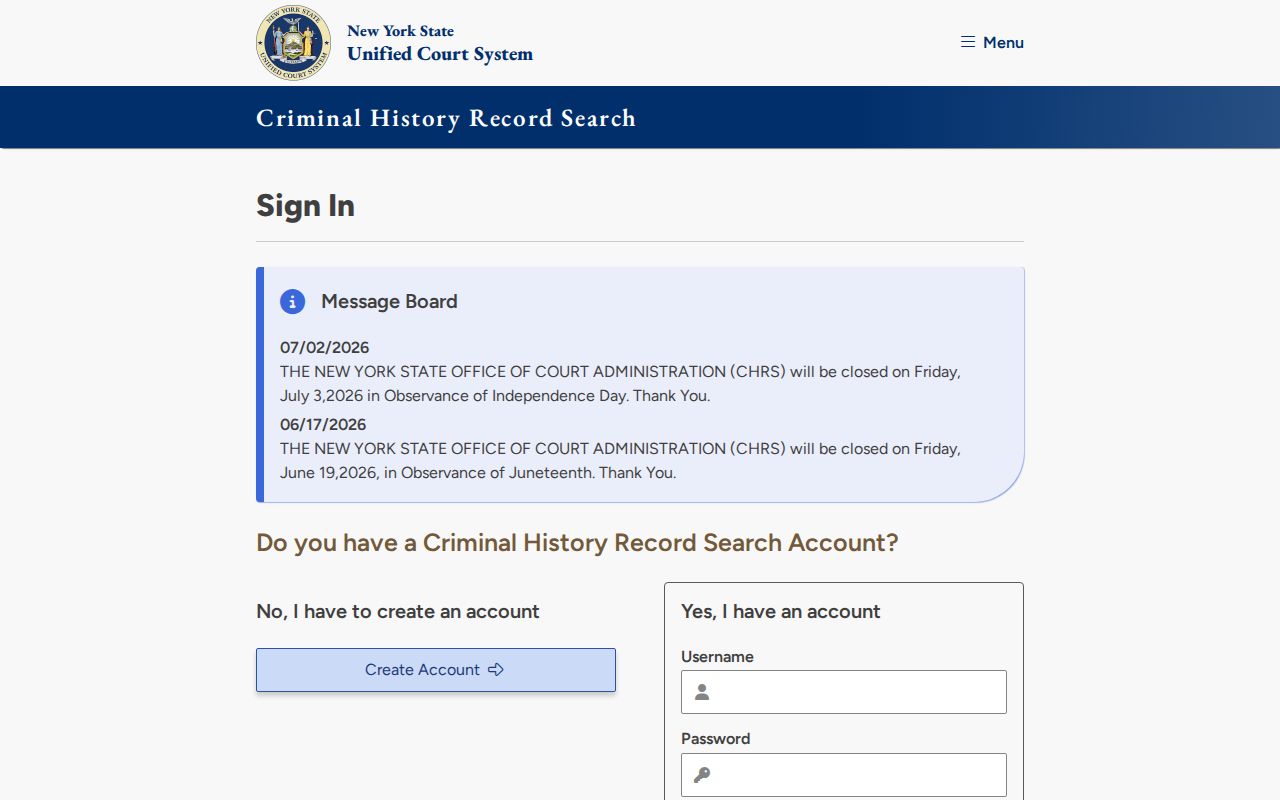
That interface produces a name-based OCA report, while a certified Essex County disposition still comes from the court that holds the case.
What a Criminal Case File Contains
An Essex County criminal case file follows charges as they are prosecuted. It is distinct from the police report and jail booking sheet. The file may show the accusatory instrument, later amendments, court appearances, motion practice, plea or trial result, and sentence. Not every item is public. Grand-jury minutes remain secret, and victim details, full birth dates, Social Security numbers, protected addresses, sealed documents, and some discovery may be withheld or redacted.
| Case number and court | The docket identifier, originating court, judge, and any linked lower-court or indictment number. |
|---|---|
| Charging document | The complaint, information, or indictment and the cited Penal Law or Vehicle and Traffic Law sections. |
| Docket events | Arraignment, appearances, adjournments, motions, orders, warrant, bail, or remand entries. |
| Parties and counsel | The defendant and attorneys, subject to limits on personal data. |
| Disposition | The plea, verdict, dismissal, acquittal, or other recorded outcome. |
| Sentence | Custody, probation, fine, surcharge, restitution, and other terms recorded by the court. |
These are expected clerk-file elements drawn from official system descriptions. They are not claimed as visible columns from a complete online Essex County sample file.
Reading Essex County Case Terms
A docket is the dated list of events in a case. It is not the full file. Read the accusatory instrument beside the disposition and sentence so that an early allegation is not mistaken for the final charge. An indictment is a grand-jury felony accusation. An information is another accusatory instrument used to prosecute charges. A certificate of disposition is the clerk-certified statement of the case outcome.
- Arraignment
- The first formal court appearance on the charges.
- Disposition
- The outcome recorded by the court, such as conviction, dismissal, or acquittal.
- ACD
- An adjournment in contemplation of dismissal, which delays the case while stated conditions apply.
- Remand
- Custody without release while the case remains before the court.
- Sealing
- A statutory limit on public visibility, not routine destruction of every record.
“Pending” means no final outcome has been entered. “Disposed” means the court recorded an outcome. Neither label alone explains what happened, so read the dated entry and obtain a certificate if the result matters.
Criminal Case Stages in Essex County
A case can begin after a police agency files an accusatory instrument in a Town or Village Justice Court. The court conducts arraignment. The prosecutor then evaluates the filed charges. A felony may advance through a grand jury and move to Supreme Court, while a misdemeanor can remain in the local court. Pretrial motions and conferences follow. The case may end through dismissal, plea, acquittal, or conviction after trial, with sentencing entered when required.
Case flow: Charges Filed › Arraignment › Pretrial › Plea or Trial › Disposition › Sentencing
That flow is why an arrest charge and a later case result may differ. The arresting agency records its allegation at one point in time. The prosecutor may reduce, replace, or decline a charge, and the court records what was actually filed and resolved. For arrest and booking context before prosecution, use the Essex County Arrest Search.
Essex Arrest Charges May Change
If a police report and Essex County court case list different charges, do not merge them into one claim. Match the incident number, local docket, indictment number, and dates. Then ask the court for the most recent accusatory instrument and final disposition. Charges at arrest are accusations. They may be reduced, replaced by an information or indictment, dismissed, or end in acquittal.
The District Attorney’s office works with the Sheriff, State Police, and the Lake Placid, Ticonderoga, Moriah, and Saranac Lake police departments. It prosecutes before both central and local courts. That broad reach does not turn its office into a case-search desk. Court records come from the clerk, while police narratives come from the agency that made the report.
Note: Tie each stage to its own source before treating an arrest allegation, filed charge, and conviction as the same fact.
Essex Clerk Certified Case Dispositions
A certificate of disposition is the clearest court-issued proof of an Essex County case outcome. Ask the court that owns the file. A Supreme or County Court certificate comes through the Elizabethtown clerk. A local case may still belong to its Town or Village Justice Court. The clerk can explain the current request form, identification need, copy charge, and retrieval time. No Essex-specific criminal copy or certification fee was published in the research, so confirm the current amount rather than assuming one.
The Essex County Clerk site and IQS link may appear in a broad county-record search, but IQS is principally a recorded-document system. It must not be treated as the county criminal docket. The captured IQS page illustrates that important boundary.
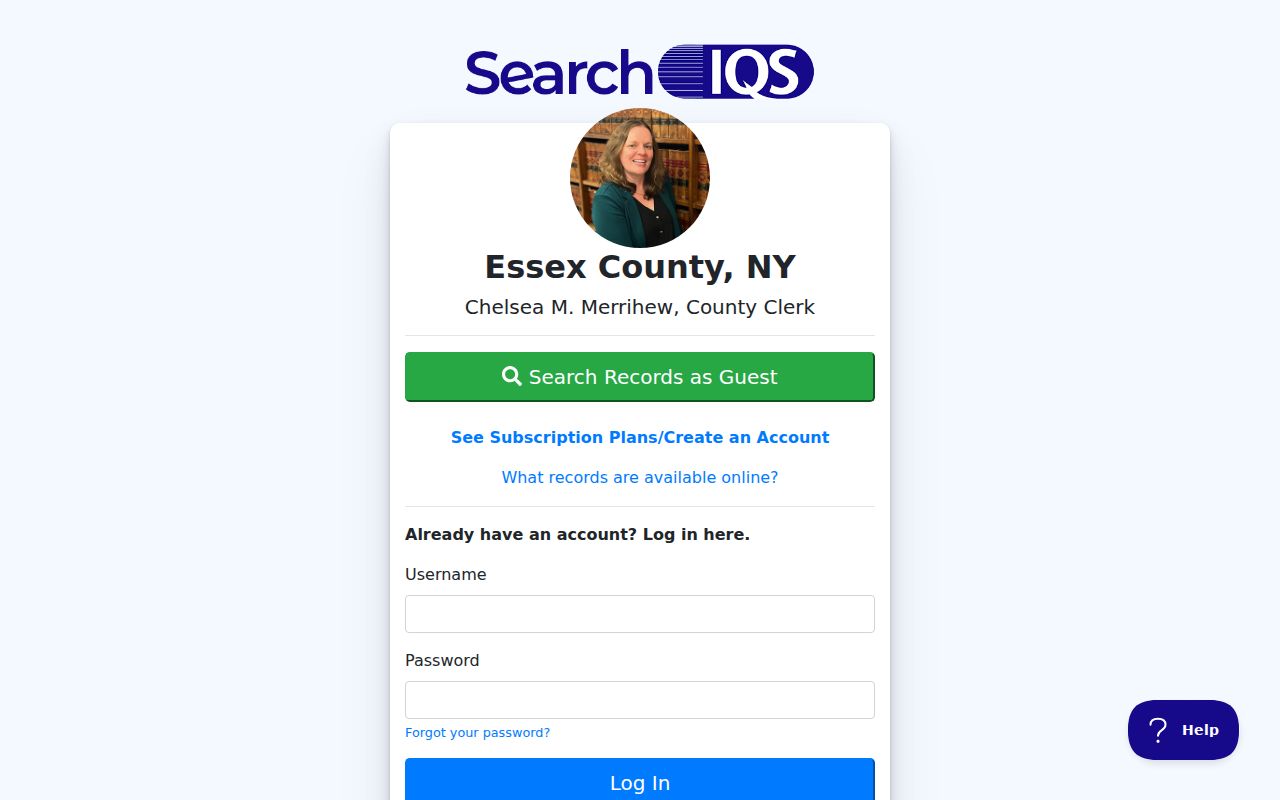
Criminal case copies and certificates remain a court-clerk task even when another county records interface looks like a general search portal.
Access Rules for Case Records
Judiciary Law section 255 directs a court clerk to diligently search and certify records in the clerk’s custody when required fees are paid. Court-file access is therefore requested from the judiciary, not through the county FOIL channel. FOIL applies to agency records, but it is not the route for a clerk’s case file.
Public access has firm limits. Records from cases terminated in the accused’s favor are generally sealed under CPL 160.50. Clean Slate under CPL 160.57 also seals eligible convictions after statutory conditions and waiting periods. Youthful-offender matters and Family Court records are confidential. Victim data, protected addresses, personal identifiers, grand-jury material, sealed filings, and some discovery may be withheld. A clerk may release a redacted public part while protecting the rest.
Search rule: A missing online result can reflect sealing, an exact-match error, a local reporting gap, or an older clerk-held file. Confirm it with the originating court.
Call before a long Adirondack records trip. Ask whether the file is onsite or archived, whether staff need retrieval time, and whether an appointment is needed. Bring photo identification and allow for security screening. Accessibility and interpreter needs should be raised with the court in advance. The official court page does not publish dependable parking, locker, phone, or photography rules.